The session invited participants to reflect on water quality realities across villages, cities, and rivers, and to collectively examine the landscape: Why does contamination persist? Where are current responses falling short? And how can stakeholders work together to address these challenges more effectively?
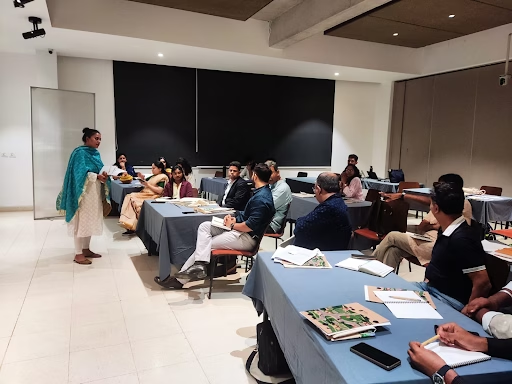
To deepen the discussion, participants were divided into three groups focusing on different water contexts: Villages – led by Viji John (Aarushya Foundation), Cities – led by Sachin Tiwale (ATREE) ,Rivers – led by Madhuri Mandava (Paani Earth Foundation) and facilitated by Anurag Rathore (INREM Foundation). Each group began with a short framing by the lead presenter, followed by an open discussion where participants shared experiences, insights, and challenges from their work.
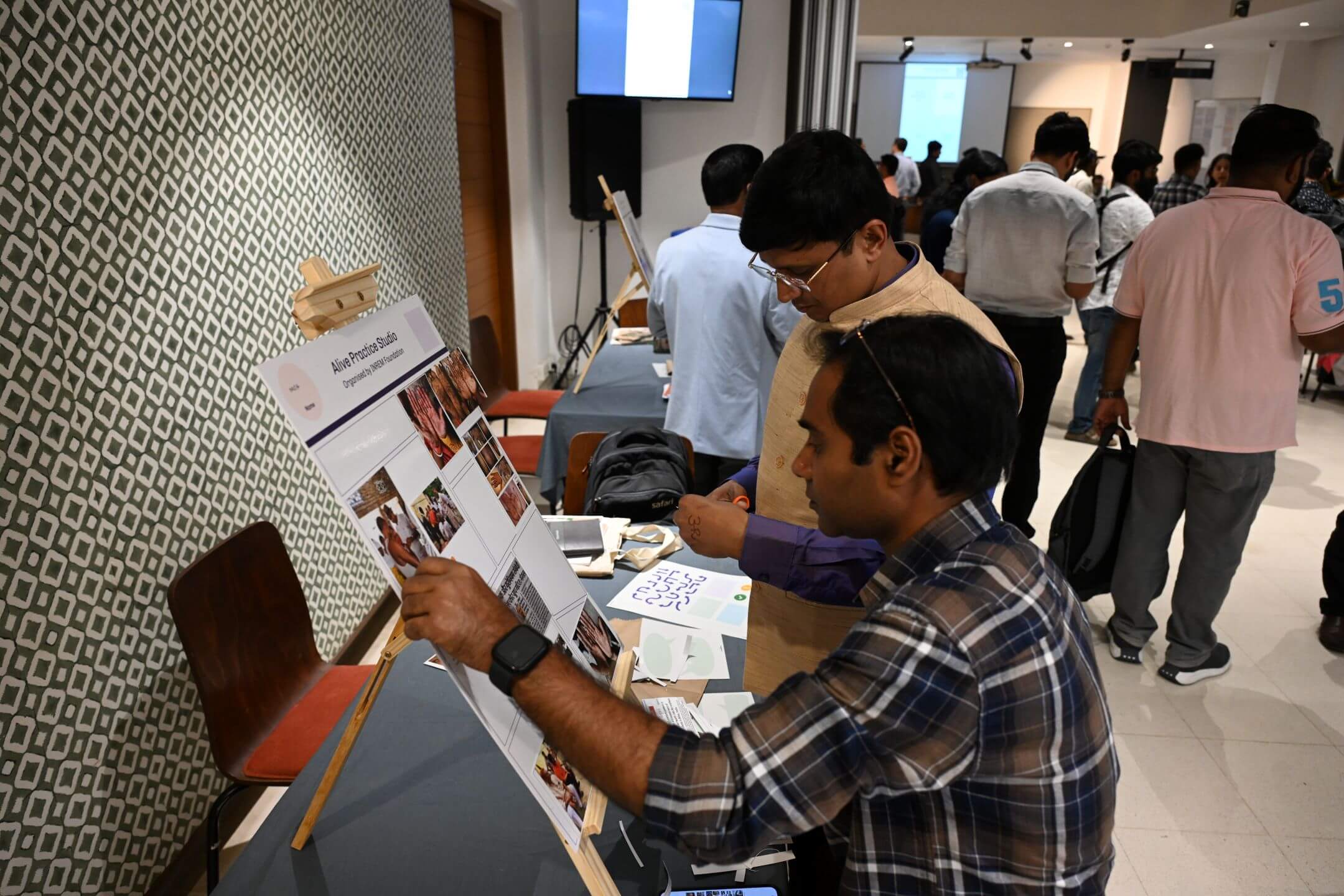
The second half of the session featured an interactive “Challenges and Solutions” exercise, where participants identified key challenges and proposed possible solutions within their respective contexts. Through a structured exchange, the proposed solutions were tested against identified challenges, encouraging participants to critically examine their practicality and relevance.
Villages: Community-Level Water Quality Challenges
The Villages group discussion focused on the realities of ensuring safe drinking water in rural areas. Viji John shared field-based insights into the challenges communities face in accessing safe water despite the expansion of infrastructure. Participants discussed the continued dependence on groundwater sources such as borewells and handpumps, which are often vulnerable to contamination. Even where water supply schemes exist, challenges remain in ensuring consistent monitoring, maintenance of infrastructure, and sustained community engagement.
The discussion also reflected on the implementation of programmes such as the Jal Jeevan Mission, highlighting both progress and ongoing challenges in translating infrastructure expansion into reliable water quality assurance. During the interactive activity, participants identified several recurring challenges at the village level, including: Irregular water quality testing and monitoring, Limited awareness about contamination risks, Infrastructure gaps and maintenance challenges, Difficulties in sustaining community participation and Groundwater contamination and source vulnerability. Participants suggested a range of possible responses, such as strengthening community awareness programmes, improving the use of field testing kits, encouraging behavioural change at household and village levels, and strengthening coordination between local governance institutions and technical agencies.
Cities: Governance and Infrastructure Challenges
The Cities group explored the systemic challenges associated with urban water management, including infrastructure planning, governance structures and water quality monitoring. Participants highlighted the lack of coordination between urban planning authorities and water supply departments. For example, rapid urban redevelopment and increasing building density often occur without corresponding adjustments in water infrastructure capacity.
Water metering was identified as a key step toward improving water management in cities, as it enables utilities to monitor consumption, audit supply, and manage demand. However, policy gaps and institutional challenges continue to limit widespread implementation. Another issue raised was the large volume of private groundwater extraction in cities, which remains poorly documented and regulated. This makes it difficult to accurately assess water demand and plan sustainable supply systems. Participants also discussed the limited availability of real-time water quality data, especially compared to other environmental indicators such as air quality. Some participants suggested developing data platforms that could link water quality information with public health indicators to improve decision-making.
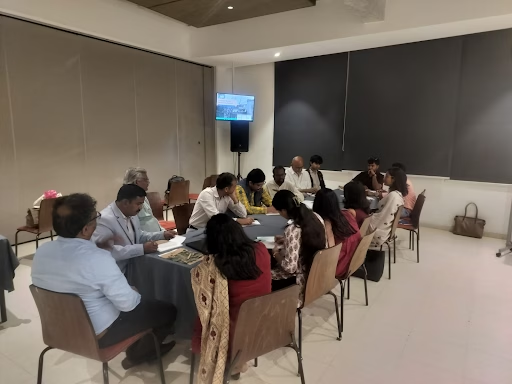
The discussion also highlighted the difference between permissible water quality standards and desirable potable water standards, noting that many urban systems aim only to meet minimum regulatory limits. Concerns were also raised about contamination during storage and distribution, particularly in low-income settlements where storage tanks and supply points may be poorly maintained. Participants suggested strengthening governance frameworks, improving transparency in water quality data, and encouraging decentralized monitoring efforts at the community or housing society level.
Rivers: Monitoring, Pollution and Ecological Stress
The Rivers breakout session focused on the growing pressures faced by river ecosystems and their implications for water quality.
Participants discussed examples from river systems such as the Arkavathi River, a tributary of the Cauvery originating from Nandi Hills. In many regions, rivers continue to serve multiple functions including drinking water supply, irrigation, and industrial use despite growing concerns about pollution and declining water quality. Monitoring efforts in several locations have included water quality testing across multiple sites and across pre-monsoon and post-monsoon seasons. These monitoring efforts provide important insights into seasonal variations in pollution levels.
Participants raised several concerns regarding river water quality management, including industrial effluent discharge, sewage inflows, weak enforcement of environmental regulations, and limited monitoring data. Other challenges included encroachment and the narrowing of river channels, as well as the transformation of many rivers into open drains in urban areas. Organic pollution and high biological oxygen demand (BOD) levels were identified as key indicators of deteriorating river health.
Participants emphasized the need for stronger monitoring systems, improved enforcement of environmental regulations, and updated water quality parameters to better reflect current pollution realities.
Connecting as a Network
The final segment of Session 1, titled “Connecting as a Network,” brought participants back together in the main hall for a collective reflection on the discussions.
The session featured an interactive dialogue with Gopal Garg from Ashoka India. He supports organizations in redesigning their strategies through the use of technology, data, and ecosystem approaches, while encouraging them to move beyond siloed approaches and work as networks. The discussion began by reflecting on the solutions proposed during the breakout sessions. Gopal invited participants to consider an important question: who actually implements the solutions that are designed to address water challenges?
Participants reflected that many of the individuals designing solutions working in NGOs, government institutions, or research organizations are often not the ones directly experiencing the water quality challenges. Communities affected by contamination frequently adapt to existing conditions rather than shaping the solutions intended for them.
Another insight that emerged was that solutions are often designed before the problem has been fully understood. When implementation begins, the nature of the problem may evolve or reveal new complexities. This highlights the importance of grounding solutions in real-world contexts and learning continuously from community experiences.
Participants also discussed the role of markets in shaping responses to water challenges. The rapid spread of household RO filtration systems was cited as an example of how market-driven solutions often emerge when public systems fail to ensure safe water. While these solutions address immediate concerns, they also raise questions about long-term sustainability and equity.
The conversation ultimately returned to the role of networks. Water quality challenges cut across villages, cities, and river systems, and no single organization or sector can address them alone. Working as a network allows stakeholders including governments, civil society organizations, researchers, and communities to share knowledge, align strategies, and collectively address systemic challenges.
The session concluded with a reflection that if water challenges are interconnected, the responses must also be interconnected. Building collaborative networks can help ensure that solutions are more inclusive, grounded in local realities, and capable of addressing the complex nature of water quality challenges.
Three landscapes of Rivers, Villages and Cities, merged into one single mosaic when the connections between one’s upstream problem, and other’s downstream realities emerged.
When we take 3 different problem scenarios here:
Rural aquifers are running out of shallow water. Deeper aquifers are chemically contaminated. The only recourse being river water to be supplied.
River waters have city drainage and industrial waste running through them, and even they are not the go-to they were for water needs.
Cities themselves, though able to harness far away water, suffer from decaying underground systems, leakages and epidemics.
When we put these three perspectives together, the landscapes become one. Each of our work has a valuable place for the “System” problem of polluted water bodies, suffering ecosystems, and health epidemics for human societies. When we bring our problems together, they seem to merge into one common mosaic that puts the need forward for mutually interdependent work.
Three action points emerge from here:
How do we make information and data as something that citizens can generate, share and actions thrive on such data?
How can learning experiences be enhanced with our collective experiences and structured and informal learning be facilitated between all of us?
Are there opportunities for mutually beneficial regional, place-based collectives that can build on our complementary viewpoints, and help each other’s own work?
Here, we call for ideas on each of the above, and will reach out to participants for their participation, based on interest.